November 24, 2015

Government Nullification with an Ineligible President of the United States

A republic is a system of government which derives its power from the people. The Founders rejected a monarchy as a violation of the God given rights to life, liberty, and the pursuit of happiness to establish a representational form of government. The Constitution of the United States, ratified in 1789, created a federal republic that repealed and replaced the confederation of the states established after the Declaration Independence, July 4, 1776. The Articles of Confederation and Perpetual Union, ratified in 1783, was the first attempt at a republican form of government. The original 13 British colonies became independent states after The American Revolution. Each of the independent states had a republican form of government with a governor elected by the people of each state as its executive officer. The republican form of government is one in which the powers of sovereignty are vested in the people and are exercised through representatives to whom the powers of sovereignty are delegated. "[A]t the Revolution, the sovereignty devolved on the people; and they are truly the sovereigns of the country, ...". See Chisholm v. Georgia (US) 2 Dall 419, 454, 1 L Ed 440, 455 @Dall (1793) pp 471-472. "The very meaning of 'sovereignty' is that the decree of the sovereign makes law." American Banana Co. v. United Fruit Co., 29 S.Ct. 511, 513, 213 U.S. 347, 53 L.Ed. 826, 19 Ann. Cas. 1047. A republican form of government is one in which the powers of sovereignty are vested in the people and are exercised by the people, either directly, or through representatives chosen by the people, to whom those powers are specially delegated. See In re Duncan, 139 U.S. 449, 11 S.Ct. 573, 35 L.Ed. 219; Minor v. Happersett, 88 U.S. (21 Wall.) 162, 22 L.Ed. 627. Black's Law Dictionary, Fifth Edition, p. 626. The United States shall guarantee to every state in this union a republican form of government, and shall protect each of them against invasion; and on application of the legislature, or of the executive (when the legislature cannot be convened) against domestic violence. Article IV, §4, U.S. Const. The People may amend or abolish the U.S. Constitution in times of unhappiness at the ballot box. The "fundamental principle of republican government, which admits the right of the people to alter or abolish the established Constitution, whenever they find it inconsistent with their happiness ...," Publius [Alexander Hamilton], The Federalist No. 78, June 14, 1788. "Until the people have, by some solemn and authoritative act, annulled or changed the established form, it is binding upon themselves collectively, as well as individually; and no presumption, or even knowledge, of their sentiments, can warrant their representatives in a departure from it, prior to such an act." All federal and state judges, all federal and state legislatures, and all federal and state executive branch officers are bound by oath to support the U.S. Constitution pursuant to Article VI. The Supreme Court of the United States has opined the Constitution was established directly by the people of the United States and not by the states. Chief Justice John Jay opined, "[The people] made a Confederation of the States the basis of a general government [i.e. the Articles of Confederation]. Experience disappointed the expectations they had formed from it, and then the people, in their collective and national capacity, established the present Constitution. It is remarkable that, in establishing it, the people exercised their own rights, and their own proper sovereignty, and, conscious of the plenitude of it, they declared with becoming dignity, 'We the people of the United States, do ordain and establish this Constitution.' Here we see the people acting as sovereigns of the whole country, and, in the language of sovereignty, establishing a Constitution by which it was their will that the State governments should be bound, and to which the State Constitutions should be made to conform. Every State Constitution is a compact made by and between the citizens of a State to govern themselves in a certain manner, and the Constitution of the United States is likewise a compact made by the people of the United States to govern themselves as to general objects in a certain manner." See Chisholm v. Georgia, 2 U.S. (2 Dall.) 419 (1793). The Supreme Court has rejected to idea that the Constitution is a compact between the States, stating, "The Constitution of the United States was ordained and established not by the States in their sovereign capacities, but emphatically, as the preamble of the Constitution declares, by 'the people of the United States.' . . . The Constitution was for a new Government, organized with new substantive powers, and not a mere supplementary charter to a Government already existing. The Confederation was a compact between States, and its structure and powers were wholly unlike those of the National Government. The Constitution was an act of the people of the United States to supersede the Confederation, and not to be ingrafted on it, as a stock through which it was to receive life and nourishment." See Martin v. Hunter's Lessee, 14 U.S. (1 Wheat.) 304 (1816). The Constitution is binding on the States and cannot be negated by the States. The Supreme Court opined, "The government proceeds directly from the people; is 'ordained and established' in the name of the people, and is declared to be ordained, 'in order to form a more perfect union, establish justice, insure domestic tranquillity, and secure the blessings of liberty to themselves and to their posterity.' ... It required not the affirmance, and could not be negatived, by the State Governments. The Constitution, when thus adopted, was of complete obligation, and bound the State sovereignties." See McCulloch v. Maryland, 17 U.S. (4 Wheat.) 316 (1819). In a constitutional republic, no government is sovereign. The sovereign delegates authority to the government and grants sovereign immunity to the government. The sovereign must retain its power to restrain the government the People have created to form a more perfect union. The People are the final authority on the interpretation of US law. The People are omnipotent and answer only to God. Nullification of unconstitutional acts perpetuated by the US federal government can only be accomplished by the People at the ballot box in a national referendum.

November 10, 2015

America's Second Declaration of Independence

The original Declaration of Independence, 1776, did not limit the People's right to abolish only the British government's representation. The original Declaration of Independence, 1776, declared the People's right to abolish "any" government in times of unhappiness. "That whenever any Form of Government becomes destructive of these ends, it is the Right of the People to alter or to abolish it, and to institute new Government, laying its foundation on such principles and organizing its powers in such form, as to them shall seem most likely to effect their Safety and Happiness." The Declaration of Independence, 1776. The Supreme Court of the United States opined, "[Citizenship] carries with it the privilege of full participation in the affairs of our society, including the right to speak freely, to criticize officials and administrators, and to promote changes in our laws including the very Charter of our Government." Knauer v. United States, 328 U.S. 654, 658 (1946). Post Revolutionary War, the mechanism to abolish and replace the US federal government is to elect an ineligible President to the Office of the President of the United States. Article II, section 1, clause 5 states, "No person except a natural born citizen, or a citizen of the United States, at the time of the adoption of this Constitution, shall be eligible to the office of President ...". This does not mean the People cannot elect an ineligible President, it means the People, as the sovereign, void the US Constitution if it chooses to elect an ineligible President. In June of 2008, US federal officers in the US Department of State fraudulently cancelled President Obama's Certificate of Loss of Nationality (CLN) issued to him in 1968 by Secretary of State Dean Rusk. Secretary Rusk issued a CLN to President Obama pursuant to his naturalization in a foreign state and parental request. In 1971, President Obama returned to the United States and requested asylum as a minor with foreign nationality abandoned by his parents. President Obama was a permanent resident alien in the United States until naturalizing as a US citizen on September 16, 1983. Naturalized US citizens are not eligible to be President of the United States. An ineligible President is not enjoined from being sworn into office or removed from office after a majority of the People have decided to declare their independence from the US federal government. The election of an ineligible President is an mechanism the People use to void the U.S. Constitution and declare their independence form the current government. The common law principle with respect to the allegiance of a citizen is that no one could disabuse himself of his obligations to his country or abjure his allegiance without the consent of the sovereign. Dyer, 298b; 1 Bl. Com. 370. Also, Shanks v. Dupont, 3 Pet. (28 U. S.) 242, 7 L. ed. 666; Inglis v. Sailor's Snug Harbor, 3 Pet. (28 U. S.) 99, 7 L. ed. 617. Wiliiams Case, 2 Cranch (C. C.), 82, note, Fed. Gas. No. 17,708. "As to whether allegiance can be acquired or lost by any other means than statutory naturalization is left by Congress in precisely the same situation as it was before the passage of their act.” Comitis v. Parkerson, 56 Fed. 556, 559. 22 L. R. A. 148. In America, the People are sovereign. Citizens, as members of the sovereign, must consent to termination of allegiance and obligations to the state before a loss of nationality may occur. President Obama did not request his CLN to be cancelled in 2008. President Obama did not request his Certificate of Naturalization issued in 1983 to be cancelled. Nevertheless, US federal officers fraudulently cancelled these documents in 2008 to prevent the sovereign from disabusing itself from the US federal government. Once acquired, citizenship cannot be diluted or cancelled at the will of the Federal Government or any governmental unit. Afroyim v. Rusk, 387 U.S. 253, 262 (1967). Under the common law principle of sovereignty and the founding principles of this nation, the US federal government is powerless to prevent the will of the majority from installing an ineligible President in violation of Article II. The Court of Appeals, District of Columbia, found review of loss of nationality determinations by the Bureau of Consular Affairs at the time President Obama's CLN was cancelled to be arbitrary and capricious and disabused the State Department from its claim of Chevron Deference. "The agency’s statutory interpretation of Section 1 of the INA [Immigration and Nationality Act of 1952. Pub. L. No. 414, 66 Stat. 163 (1952) (codified as amended at 8 U.S.C. § 1101 et seq. (2006)), under Section 349(a)(1), naturalization in a foreign state, 8 U.S.C. § 1481(a)(1).], as rendered in the Betancourt Letter [describing Department of State, Board of Appellate Review; Review of Loss of Nationality, Final Rule, 73 Fed. Reg. 62,196, 62,196 (Oct. 20, 2008). ], is not entitled to Chevron deference." Fox v. Clinton, 684 F. 3d 67 - 2012. January 20, 2009 was America's Second Declaration of Independence.

November 02, 2015

An Ineligible President of the United States Voids the Constitution

It is a common misconception that the opinion of the Supreme Court of the United States (SCOTUS) is the final word on the interpretation of the supreme law of the land. Article VI. ("This Constitution, and the laws of the United States which shall be made in pursuance thereof; and all treaties made, or which shall be made, under the authority of the United States, shall be the supreme law of the land; ...") The People are sovereign and SCOTUS is a servant of the sovereign restrained by the US Constitution. SCOTUS opinion is authoritative until the People withdraw their consent for SCOTUS to have an opinion. The people withdraw their consent for SCOTUS to have an opinion when an ineligible President is sworn into office. The Federalist No. 78; The Judiciary Department; "There is no position which depends on clearer principles, than that every act of a delegated authority, contrary to the tenor of the commission under which it is exercised, is void. No legislative act, therefore, contrary to the Constitution, can be valid. To deny this, would be to affirm, that the deputy is greater than his principal; that the servant is above his master; that the representatives of the people are superior to the people themselves; that men acting by virtue of powers, may do not only what their powers do not authorize, but what they forbid." - Publius (Alexander Hamilton). The Declaration of Independence proclaimed the People are endowed by the Creator with unalienable rights. These rights include the right to withdraw consent to be governed by any government, not just the British government. The People do not formalize a declaration of independence and engage in war to withdraw consent to be governed by the US federal government. The People withdraw consent to be governed by the US federal government through the election of an ineligible President to be sworn into office in violation of Article II. Pursuant to Article VI, "The Senators and Representatives before mentioned, and the members of the several state legislatures, and all executive and judicial officers, both of the United States and of the several states, shall be bound by oath or affirmation, to support this Constitution; ..." The sovereign is immune from lawsuit for conspiring to violate Article II after they have been endowed with unalienable rights by the Creator. The sovereign cannot be enjoined by its servants to prevent violence against the Constitution. The servants cannot ignore a violation of Article II by a sitting President installed into office by the will of the majority at the ballot box. As a member of the sovereign, a native born US citizen may have dual allegiance at birth. Amendment XIV. "All persons born or naturalized in the United States, and subject to the jurisdiction thereof, are citizens of the United States and of the state wherein they reside. No state shall make or enforce any law which shall abridge the privileges or immunities of citizens of the United States; nor shall any state deprive any person of life, liberty, or property, without due process of law; nor deny to any person within its jurisdiction the equal protection of the laws." Allegiance is acquired a birth. The common law was that a citizen or subject could not renounce their allegiance without the consent of the sovereign. See Dyer, 298b; 1 Bl. Com. 370. "[The Fourteenth] Amendment can most reasonably be read as defining a citizenship which a citizen keeps unless he voluntarily relinquishes it. Once acquired, this Fourteenth Amendment citizenship was not to be shifted, canceled, or diluted at the will of the Federal Government, the States, or any other governmental unit." Afroyim v. Rusk, 387 U.S. 253, 87 S.Ct. 1665, 18 L.Ed.2d 757 (1967). The court said in Comitis v. Parkerson, 56 Fed. 556, 559. 22 L. R. A. 148: "As to whether allegiance can be acquired or lost by any other means than statutory naturalization is left by Congress in precisely the same situation as it was before the passage of [U.S. Rev. Stat, §§ 1999-2000, 1868]." A native born US citizen may naturalize in a foreign state to obtain dual allegiance. The servants of the People are powerless to stop them. See Kahane v. Shultz, 653 F. Supp. 1486 - 1987 - ‎Dist. Court, ED New York. In Osborn v. Bank of the United States, 22 U.S. 738 (1824): "A naturalized citizen is indeed made a citizen under an act of Congress, but the act does not proceed to give, to regulate, or to prescribe his capacities. He becomes a member of the society, possessing all the rights of a native citizen, and standing, in the view of the constitution, on the footing of a native. The constitution does not authorize Congress to enlarge or abridge those rights." The U.S. federal government is not authorized to define the term natural born citizen because it would enlarge the citizenship rights of some Americans and abridge the citizenship rights of other Americans contrary to the authority delegated to the U.S. federal government. The US federal government, including SCOTUS, is not authorized to prevent an ineligible President from assuming office. The U.S. federal government is not constitutionally authorized to ignore a violation of Article II by a sitting President. An ineligible sitting President voids the U.S. Constitution and terminates the authority delegated to the U.S. federal government. The People obtain independence from the U.S. federal government by electing and installing an ineligible President.

October 05, 2015

A Poison Pill Defense Against Government Tyranny

A poison pill defense is a mechanism to fend off encroachment from an unwanted suitor. Justice Joseph Story wrote of the purpose of the natural born citizenship clause, Article II, section 1, clause 5, U.S. Constitution, to exclude persons under the influence of a foreign power, "[T]he general propriety of the exclusion of foreigners, in common cases, will scarcely be doubted by any sound statesman. It cuts off all chances for ambitious foreigners, who might otherwise be intriguing for the office; and interposes a barrier against those corrupt interferences of foreign governments in executive elections, which have inflicted the most serious evils upon the elective monarchies of Europe." See Commentaries on the Constitution of the United States § 1473, at 333 (1833). A republic is a system of government which derives its power from the people. The Founders rejected a monarchy as a violation of the God given rights to life, liberty, and the pursuit of happiness through a representational form of government. Common Sense, by Thomas Paine, promoted republican ideals and independence to the larger public. The Constitution of the United States, ratified in 1789, created a federal republic that repealed and replaced the confederation established after the Declaration Independence, July 4, 1776. The Articles of Confederation and Perpetual Union, ratified in 1783, was the first attempt at a republican form of government. Article IV of the United States Constitution "guarantee[s] to every State in this Union a Republican form of Government". The Preamble of the U.S. Constitution makes clear, "We the people of the United States ... do ordain and establish this Constitution for the United States of America. Republics use the term president to describe the head of state. The original 13 British colonies became independent states after the American Revolution. Each of the independent states had a republican form of government with a governor elected by the people of each state as its executive officer. The republican form of government is one in which the powers of sovereignty are vested in the people and are exercised through representatives to whom the powers of sovereignty are delegated. "[A]t the Revolution, the sovereignty devolved on the people; and they are truly the sovereigns of the country, ...". See Chisholm v. Georgia (US) 2 Dall 419, 454, 1 L Ed 440, 455 @Dall (1793) pp 471-472. "The very meaning of 'sovereignty' is that the decree of the sovereign makes law." American Banana Co. v. United Fruit Co., 29 S.Ct. 511, 513, 213 U.S. 347, 53 L.Ed. 826, 19 Ann. Cas. 1047. A republican form of government is one in which the powers of sovereignty are vested in the people and are exercised by the people, either directly, or through representatives chosen by the people, to whom those powers are specially delegated. See In re Duncan, 139 U.S. 449, 11 S.Ct. 573, 35 L.Ed. 219; Minor v. Happersett, 88 U.S. (21 Wall.) 162, 22 L.Ed. 627. Black's Law Dictionary, Fifth Edition, p. 626. The United States shall guarantee to every state in this union a republican form of government, and shall protect each of them against invasion; and on application of the legislature, or of the executive (when the legislature cannot be convened) against domestic violence. Article IV, §4, U.S. Const. The Senators and Representatives [...] and the members of the several state legislatures, and all executive and judicial officers, both of the United States and of the several states, shall be bound by oath or affirmation, to support this Constitution; but no religious test shall ever be required as a qualification to any office or public trust under the United States. Article VI, clause 3, U.S. Const. "The United States has no voters in the States of its own creation. The elective officers of the United States are all elected directly or indirectly by State voters." See Minor v. Happersett, 88 U.S. (21 Wall.) 162, 22 L.Ed. 627. The People are sovereign. The sovereign may amend or abolish the U.S. Constitution in times of unhappiness at the ballot box. The "fundamental principle of republican government, which admits the right of the people to alter or abolish the established Constitution, whenever they find it inconsistent with their happiness ...," Publius [Alexander Hamilton], The Federalist No. 78, June 14, 1788. "Until the people have, by some solemn and authoritative act, annulled or changed the established form, it is binding upon themselves collectively, as well as individually; and no presumption, or even knowledge, of their sentiments, can warrant their representatives in a departure from it, prior to such an act." All federal and state judges, all federal and state legislators, and all federal and state executive branch officers are bound by oath to support the U.S. Constitution until abolished through verified vote by the sovereign. Article II of the U.S. Constitution is a poison pill defense against the usurpation of the Office of the President of the United States by a person with allegiance to a foreign power. An ineligible sitting President is not removed or prevented from performing his duties by the Congress or the courts. The People are omnipotent and cannot be denied the chosen leader. The U.S. Constitution is voided when an ineligible President assumes the highest office in the land to prevent the usurper from inheriting a functioning constitutional republic. After installing an ineligible President, the People must renew the constitutional republic with an improved national governing document ratified through a national referendum.

September 24, 2015

The Consent of the Governed May Be Withdrawn

The rule of law is a founding principle of the nation mandating that the law governs everyone, the law must be published and available to the public for viewing, and the law must be archived for reference. Another founding principle of the nation is the People have unalienable rights endowed by the Creator where all persons are created equal. Governments are instituted by the People and governments derive their just powers from the consent of the governed. Governments should have a legitimate purpose and be limited by enumerated powers for the protection of the unalienable rights of the People. And finally, it is a founding principle of this nation the People may withdraw their consent to be governed from any government A quote from a transcript of The Declaration of Independence, 1776, held by the U.S. National Archives and Records Administration:

IN CONGRESS, July 4, 1776. The unanimous Declaration of the thirteen united States of America,

When in the Course of human events, it becomes necessary for one people to dissolve the political bands which have connected them with another, and to assume among the powers of the earth, the separate and equal station to which the Laws of Nature and of Nature's God entitle them, a decent respect to the opinions of mankind requires that they should declare the causes which impel them to the separation. We hold these truths to be self-evident, that all men are created equal, that they are endowed by their Creator with certain unalienable Rights, that among these are Life, Liberty and the pursuit of Happiness.--That to secure these rights, Governments are instituted among Men, deriving their just powers from the consent of the governed, --That whenever any Form of Government becomes destructive of these ends, it is the Right of the People to alter or to abolish it, and to institute new Government, laying its foundation on such principles and organizing its powers in such form, as to them shall seem most likely to effect their Safety and Happiness. Prudence, indeed, will dictate that Governments long established should not be changed for light and transient causes; and accordingly all experience hath shewn, that mankind are more disposed to suffer, while evils are sufferable, than to right themselves by abolishing the forms to which they are accustomed. But when a long train of abuses and usurpations, pursuing invariably the same Object evinces a design to reduce them under absolute Despotism, it is their right, it is their duty, to throw off such Government, and to provide new Guards for their future security.
A quote from a transcript of Article VI of the U.S. Constitution held by the U.S. National Archives and Records Administration:
This Constitution, and the laws of the United States which shall be made in pursuance thereof; and all treaties made, or which shall be made, under the authority of the United States, shall be the supreme law of the land; and the judges in every state shall be bound thereby, anything in the Constitution or laws of any State to the contrary notwithstanding. The Senators and Representatives before mentioned, and the members of the several state legislatures, and all executive and judicial officers, both of the United States and of the several states, shall be bound by oath or affirmation, to support this Constitution; but no religious test shall ever be required as a qualification to any office or public trust under the United States.
The National Archives is the U.S. Government’s collection of documents that records important events in American history. The National Archives and Records Administration (NARA) is the Government agency that preserves and maintains these materials. David S. Ferriero was appointed as the 10th Archivist of the United States in 2009 after being nominated by President Obama. All records held in trust as proof of record are suspect after an appointment by an ineligible POTUS. The President of the Chief Executive officer of the United States Federal Government. Assuming arguendo the US Constitution survives the installation of an ineligible POTUS by the will of the People, then the appointment and maintenance of records of an archivist by an ineligible POTUS certainly taints the authority and authenticity of the records of the United States. As part of the Virginia Plan submitted at the Constitutional Convention, Edmund Randolph proposed, "that the Legislative Executive & Judiciary powers within the several States ought to be bound by oath to support the articles of Union." The People are sovereign and may elect an ineligible President of the United States (POTUS) to withdraw consent to be governed by a corrupt and incompetent U.S Congress and dissolve the authority of the Supreme Court of the United States (SCOTUS). SCOTUS precedent is authoritative pursuant to Article III of the U.S. Constitution until the People withdraw consent. Electing an ineligible President is a mechanism used by the People at the ballot box to withdraw delegated authority to any government. US federal and state officers must not ignore a violation of the Eligibility Clause, Article II, Section 1, Clause 5. Article VI is a mechanism the Framers used to force the POTUS to negotiate a new constitution with the People. If US federal and state officers abandoned the ineligible POTUS pursuant to the Oath Clause of Article VI, then the POTUS would be required to negotiate a new Constitution with the People to become a functional leader. The common law principle with respect to the allegiance of a citizen is that no one could remove himself from his obligations to his country or abjure his allegiance without the consent of the sovereign. Dyer, 298b; 1 Bl. Com. 370. Also, Shanks v. Dupont, 3 Pet. (28 U. S.) 242, 7 L. ed. 666; Inglis v. Sailor's Snug Harbor, 3 Pet. (28 U. S.) 99, 7 L. ed. 617. Wiliiams Case, 2 Cranch (C. C.), 82, note, Fed. Gas. No. 17,708. "As to whether allegiance can be acquired or lost by any other means than statutory naturalization is left by Congress in precisely the same situation as it was before the passage of their act.” Comitis v. Parkerson, 56 Fed. 556, 559. 22 L. R. A. 148. The British National Archives (BNA) is an executive agency of the government of the United Kingdom. On April 18, 2012, the BNA released a batch of thousands of colonial-era files believed to have been destroyed. Researchers reported an unnamed son of Barack Obama Sr. was recorded on Aug. 4, 1961. Kenya became officially independent from the UK in 1963. BNA indicated the occurrence of at least four vital events registered to the name of Barack Obama, taking place in the British Protectorate of East Africa (Kenya) between 1953 and 1963, including the birth of two sons before 1963. The books containing hand written line records of vital events attributed to Obama are contained in Series RG36 of the Family Records section in the Kew branch of the BNA. On June 6, 1951, President Truman signed the 1951 British Treaty between the United States of America and the United Kingdom / Great Britain. This Treaty, ratified by the United States Senate, took effect on September 7, 1952. This Treaty authorizes the British Consulate to register the birth of British Subjects born in the United States of America, establishing a British jurisdiction over US Born Citizens of a British Citizen parent or parents. The Framers did not want US federal and state officers assisting an ineligible POTUS in the transitioning of America after the People have withdrawn their consent to be governed by the U.S. government. "The very meaning of sovereignty is that the decree of the sovereign makes law." See Kawananakoa v. Polyblank, 205 U. S. 349, 353 (1907). U.S. federal and state officers must stand down to preserve America's assets cultivated under a republican form of government. Abandoning the ineligible POTUS provides leverage for the People to negotiate a new constitution with the ineligible POTUS. Under the founding of this nation, US federal officers are powerless to prevent the People from installing an ineligible President. A natural born citizen is a US citizen that is not under the influence of a foreign power. Article II, which states the POTUS shall be a natural born citizen, is a defense against a POTUS influenced by a foreign power. The Framers did not want American assets to be used to destroy America or attack its allies under the direction of a POTUS under the influence of a foreign power. Article II is a poison pill defense against ineligible POTUS using America's assets against America and dismissing America's desire to renew America under a new constitution.

September 17, 2015

A Sovereign Installs an Ineligible President to Vacate the Tyranny of a Corrupt Government

The rule of law is a founding principle of the nation mandating that the law governs everyone, the law must be published and available to the public for viewing, and the law must be archived for reference. Another founding principle of the nation is the People have unalienable rights endowed by the Creator where all persons are created equal. Governments are instituted by the People and governments derive their just powers from the consent of the governed. Governments should have a legitimate purpose and be limited by enumerated powers for the protection of the unalienable rights of the People. And finally, it is a founding principle of this nation the People may withdraw their consent to be governed from any government A quote from a transcript of The Declaration of Independence, 1776, held by the U.S. National Archives and Records Administration:

IN CONGRESS, July 4, 1776. The unanimous Declaration of the thirteen united States of America,

When in the Course of human events, it becomes necessary for one people to dissolve the political bands which have connected them with another, and to assume among the powers of the earth, the separate and equal station to which the Laws of Nature and of Nature's God entitle them, a decent respect to the opinions of mankind requires that they should declare the causes which impel them to the separation. We hold these truths to be self-evident, that all men are created equal, that they are endowed by their Creator with certain unalienable Rights, that among these are Life, Liberty and the pursuit of Happiness.--That to secure these rights, Governments are instituted among Men, deriving their just powers from the consent of the governed, --That whenever any Form of Government becomes destructive of these ends, it is the Right of the People to alter or to abolish it, and to institute new Government, laying its foundation on such principles and organizing its powers in such form, as to them shall seem most likely to effect their Safety and Happiness. Prudence, indeed, will dictate that Governments long established should not be changed for light and transient causes; and accordingly all experience hath shewn, that mankind are more disposed to suffer, while evils are sufferable, than to right themselves by abolishing the forms to which they are accustomed. But when a long train of abuses and usurpations, pursuing invariably the same Object evinces a design to reduce them under absolute Despotism, it is their right, it is their duty, to throw off such Government, and to provide new Guards for their future security.
A quote from a transcript of Article VI of the U.S. Constitution held by the U.S. National Archives and Records Administration:
This Constitution, and the laws of the United States which shall be made in pursuance thereof; and all treaties made, or which shall be made, under the authority of the United States, shall be the supreme law of the land; and the judges in every state shall be bound thereby, anything in the Constitution or laws of any State to the contrary notwithstanding. The Senators and Representatives before mentioned, and the members of the several state legislatures, and all executive and judicial officers, both of the United States and of the several states, shall be bound by oath or affirmation, to support this Constitution; but no religious test shall ever be required as a qualification to any office or public trust under the United States.
The National Archives is the U.S. Government’s collection of documents that records important events in American history. The National Archives and Records Administration (NARA) is the Government agency that preserves and maintains these materials. David S. Ferriero was appointed as the 10th Archivist of the United States in 2009 after being nominated by President Obama. All records held in trust as proof of record are suspect after an appointment by an ineligible POTUS. The President of the Chief Executive officer of the United States Federal Government. Assuming arguendo the US Constitution survives the installation of an ineligible POTUS by the will of the People, then the appointment and maintenance of records of an archivist by an ineligible POTUS certainly taints the authority and authenticity of the records of the United States. As part of the Virginia Plan submitted at the Constitutional Convention, Edmund Randolph proposed, "that the Legislative Executive & Judiciary powers within the several States ought to be bound by oath to support the articles of Union." The People are sovereign and may elect an ineligible President of the United States (POTUS) to withdraw consent to be governed by a corrupt and incompetent U.S Congress and dissolve the authority of the Supreme Court of the United States (SCOTUS). SCOTUS precedent is authoritative pursuant to Article III of the U.S. Constitution until the People withdraw consent. Electing an ineligible President is a mechanism used by the People at the ballot box to withdraw delegated authority to any government. US federal and state officers must not ignore a violation of the Eligibility Clause, Article II, Section 1, Clause 5. Article VI is a mechanism the Framers used to force the POTUS to negotiate a new constitution with the People. If US federal and state officers abandoned the ineligible POTUS pursuant to the Oath Clause of Article VI, then the POTUS would be required to negotiate a new Constitution with the People to become a functional leader. The common law principle with respect to the allegiance of a citizen is that no one could remove himself from his obligations to his country or abjure his allegiance without the consent of the sovereign. Dyer, 298b; 1 Bl. Com. 370. Also, Shanks v. Dupont, 3 Pet. (28 U. S.) 242, 7 L. ed. 666; Inglis v. Sailor's Snug Harbor, 3 Pet. (28 U. S.) 99, 7 L. ed. 617. Williams Case, 2 Cranch (C. C.), 82, note, Fed. Gas. No. 17,708. "As to whether allegiance can be acquired or lost by any other means than statutory naturalization is left by Congress in precisely the same situation as it was before the passage of their act.” Comitis v. Parkerson, 56 Fed. 556, 559. 22 L. R. A. 148. The British National Archives (BNA) is an executive agency of the government of the United Kingdom. On April 18, 2012, the BNA released a batch of thousands of colonial-era files believed to have been destroyed. Researchers reported an unnamed son of Barack Obama Sr. was recorded on Aug. 4, 1961. Kenya became officially independent from the UK in 1963. BNA indicated the occurrence of at least four vital events registered to the name of Barack Obama, taking place in the British Protectorate of East Africa (Kenya) between 1953 and 1963, including the birth of two sons before 1963. The books containing hand written line records of vital events attributed to Obama are contained in Series RG36 of the Family Records section in the Kew branch of the BNA. On June 6, 1951, President Truman signed the 1951 British Treaty between the United States of America and the United Kingdom / Great Britain. This Treaty, ratified by the United States Senate, took effect on September 7, 1952. This Treaty authorizes the British Consulate to register the birth of British Subjects born in the United States of America, establishing a British jurisdiction over US Born Citizens of a British Citizen parent or parents. The Framers did not want US federal and state officers assisting an ineligible POTUS in the transitioning of America after the People have withdrawn their consent to be governed by the U.S. government. "The very meaning of sovereignty is that the decree of the sovereign makes law." See Kawananakoa v. Polyblank, 205 U. S. 349, 353 (1907). U.S. federal and state officers must stand down to preserve America's assets cultivated under a republican form of government. Abandoning the ineligible POTUS provides leverage for the People to negotiate a new constitution with the ineligible POTUS. Under the founding of this nation, US federal officers are powerless to prevent the People from installing an ineligible President. A natural born citizen is a US citizen that is not under the influence of a foreign power. Article II, which states the POTUS shall be a natural born citizen, is a defense against a POTUS influenced by a foreign power. The Framers did not want American assets to be used to destroy America or attack its allies under the direction of a POTUS under the influence of a foreign power. Article II is a poison pill defense against ineligible POTUS using America's assets against America and dismissing America's desire to renew America under a new constitution.

August 20, 2015

The Term Natural Born Citizen is Undefined

The term natural born citizen is undefined in the U.S. Constitution. Without a definition in the Constitution, the Supreme Court of the United States (SCOTUS) is not authorized to opine on its definition. The U.S. federal government is not authorized to enlarge or abridge the rights of a US citizen with respect to citizenship. The authority delegated to the Congress and the Courts through the U.S. Constitution are coextensive. Schneider v. Rusk, 377 U.S. 163 - 1964, citing Osborn v. Bank of United States, 9 Wheat. 738, 827, 6 L.Ed. 204. And see Luria v. United States, 231 U.S. 9, 22, 34 S.Ct. 10, 13, 58 L.Ed. 101; United States v. Macintosh, 283 U.S. 605, 624, 51 S.Ct. 570, 575, 75 L.Ed. 1302; Knauer v. United States, 328 U.S. 654, 658, 66 S.Ct. 1304, 1307, 90 L.Ed. 1500. SCOTUS is not authorized to use the common law at the time of the adoption of US Constitution to enlarge or abridge the rights of a US citizen with respect to citizenship. The People are sovereign and the People have not delegated authority to SCOTUS to thwart the will of the majority at the ballot box to abolish the US Constitution through the election of an ineligible President. The Federalist, No. 78. To allow SCOTUS to opine on the common law while denying Congress or the People the opportunity to respond would make SCOTUS the sovereign and deny the People their sovereign immunity after violating Article II to abolish the US Constitution. - Sven Magnussen
------------------------------------------------------------------------------------

The Federalist No. 78 The Judiciary Department Independent Journal Saturday, June 14, 1788 [Alexander Hamilton]

excerpt -
Though I trust the friends of the proposed Constitution will never concur with its enemies, in questioning that fundamental principle of republican government, which admits the right of the people to alter or abolish the established Constitution, whenever they find it inconsistent with their happiness, yet it is not to be inferred from this principle, that the representatives of the people, whenever a momentary inclination happens to lay hold of a majority of their constituents, incompatible with the provisions in the existing Constitution, would, on that account, be justifiable in a violation of those provisions; or that the courts would be under a greater obligation to connive at infractions in this shape, than when they had proceeded wholly from the cabals of the representative body. Until the people have, by some solemn and authoritative act, annulled or changed the established form, it is binding upon themselves collectively, as well as individually; and no presumption, or even knowledge, of their sentiments, can warrant their representatives in a departure from it, prior to such an act.
- PUBLIUS

President Barack Hussein Obama II Naturalized as a U.S. Citizen on September 16, 1983

The term natural born citizen is undefined in the U.S. Constitution. Without a definition in the Constitution, the Supreme Court of the United States (SCOTUS) is not authorized to opine on its definition. The U.S. federal government is not authorized to enlarge or abridge the rights of a US citizen with respect to citizenship. The authority delegated to the Congress and the Courts through the U.S. Constitution are coextensive. Schneider v. Rusk, 377 U.S. 163 - 1964, citing Osborn v. Bank of United States, 9 Wheat. 738, 827, 6 L.Ed. 204. And see Luria v. United States, 231 U.S. 9, 22, 34 S.Ct. 10, 13, 58 L.Ed. 101; United States v. Macintosh, 283 U.S. 605, 624, 51 S.Ct. 570, 575, 75 L.Ed. 1302; Knauer v. United States, 328 U.S. 654, 658, 66 S.Ct. 1304, 1307, 90 L.Ed. 1500. SCOTUS is not authorized to use the common law at the time of the adoption of US Constitution to enlarge or abridge the rights of a US citizen with respect to citizenship. The People are sovereign and the People have not delegated authority to SCOTUS to thwart the will of the majority at the ballot box to abolish the US Constitution through the election of an ineligible President. The Federalist, No. 78. To allow SCOTUS to opine on the common law while denying Congress or the People the opportunity to respond would make SCOTUS the sovereign and deny the People their sovereign immunity after violating Article II to abolish the US Constitution.
...

The Federalist No. 78 The Judiciary Department Independent Journal Saturday, June 14, 1788 [Alexander Hamilton]

excerpt of The Federalist No. 78 -
Though I trust the friends of the proposed Constitution will never concur with its enemies, in questioning that fundamental principle of republican government, which admits the right of the people to alter or abolish the established Constitution, whenever they find it inconsistent with their happiness, yet it is not to be inferred from this principle, that the representatives of the people, whenever a momentary inclination happens to lay hold of a majority of their constituents, incompatible with the provisions in the existing Constitution, would, on that account, be justifiable in a violation of those provisions; or that the courts would be under a greater obligation to connive at infractions in this shape, than when they had proceeded wholly from the cabals of the representative body. Until the people have, by some solemn and authoritative act, annulled or changed the established form, it is binding upon themselves collectively, as well as individually; and no presumption, or even knowledge, of their sentiments, can warrant their representatives in a departure from it, prior to such an act.
- PUBLIUS
...
President Obama is ineligible to assume the Office of the President of the United States after naturalizing as a U.S. citizen on September 16, 1983, Los Angeles, California. One of the responsibilities of the President is to maintain the U.S. Constitution as evidence of U.S. law. The chain of custody of maintaining the evidence of law is broken after an ineligible President assumes the Office of the President of the United States. The majority of the People have voted to install an ineligible President to fundamentally change America. In 1775, the Second Continental Congress began acting as the provisional government to run the American Revolutionary War and gain the colonies their collective independence. The provisional government appointed diplomats, issued, military commissions, adopted trade restrictions, established and maintained an army, and issued money to facilitate trade. The first constitution for the United States was replaced by the current United States Constitution on September 13, 1788. The Articles of Confederation, formally the Articles of Confederation and Perpetual Union, was a national governing document establishing the United States of America as a confederation of sovereign states and served as its first constitution. The final draft of the Articles of Confederation served as the de facto system of government used by the the United States in Congress Assembled until it became de jure by final ratification in 1781. The United States in Congress Assembled became the Congress of the Confederation. Under the Articles of Confederation, the states retained sovereignty over all governmental functions not specifically relinquished to the national government. The individual articles set the rules for current and future operations of the United States government. It was made capable of making war and peace, negotiating diplomatic and commercial agreements with foreign countries, and deciding disputes between the states. Article XIII stated the Union shall be perpetual. Although the Articles of Confederation did provide for a Congress, it did not provide for a president, a judiciary or a tax base to pay debts incurred by the confederation. In 1788, the Articles of Confederation was replaced by the United States Constitution. The original five-page Articles of Confederation contained a preamble, thirteen articles, a conclusion, and a signatory section. The preamble states that the signatory states "agree to certain articles of Confederation and perpetual Union" between the 13 states. Initially, America was governed by the Articles of Confederation. The Articles of Confederation required all states to vote for ratification of an amendment. The Founders chose to repeal and replace the Articles of Confederation with the U.S. Constitution. The U.S. Constitution has been voided by the installation of an ineligible President and must be replaced. The American people have hit the reset button. Email svenmagnussen@conventionforamerica.com to add your name, state, and email address to our ping list. Why don't we use javascript to create a nice email entry form? Javascript is the mothers-milk of data tracking. We recommend Firefox and the NoScript add-on feature for browsing. - Sven Magnussen updated August 20, 2015

June 17, 2015

NOTICE: Sven Magnussen at ConventionforAmerica.com

Click here for redirection to the home page.

June 11, 2015

U.S. Constitution, Article V

U.S. Constitution, Article VI:

All debts contracted and engagements entered into, before the adoption of this Constitution, shall be as valid against the United States under this Constitution, as under the Confederation. This Constitution, and the laws of the United States which shall be made in pursuance thereof; and all treaties made, or which shall be made, under the authority of the United States, shall be the supreme law of the land; and the judges in every state shall be bound thereby, anything in the Constitution or laws of any State to the contrary notwithstanding. The Senators and Representatives before mentioned, and the members of the several state legislatures, and all executive and judicial officers, both of the United States and of the several states, shall be bound by oath or affirmation, to support this Constitution; but no religious test shall ever be required as a qualification to any office or public trust under the United States.
Delegated authority by the people to the US federal government is withdrawn when the people elect an ineligible President. The ineligible President remains in office while the US federal government is removed. The US federal government is a servant of the people. For some oddball reason, many people believe their servants can’t be fired after a vote of the majority. A basic tenet of a constitutional republic is that all law is authenicated, published and archived. The federal courts are authorized to accept copies of the originals if a reasonable assurance can be made the originals are archived and maintained by a President and his officers who are not in violation of the US Constitution. Evidence must be preserved and protected by individuals authorized by the Constitution or the evidence is tainted. The President is the Chief Executive Officer of the US federal government. An ineligible President voids the Constitution and all US law, rules, regulations, treaties and executive orders because the chain of custody of preserving and protecting the evidence of US law is destroyed. The majority has spoken. Regardless of the fact Obama is not an natural born citizen, America has chosen to install an ineligible President into the Office of the President of the United States. An ineligible President voids the Constitution. The Congress, the Federal Courts and federal officers of the Executive Branch have lost their authority to serve the union. The U.S. Constitution must be replaced with a national charter just as the Articles of Confederation was replaced by the U.S. Constitution. The US Constitution and all other US law, rules, regulations, treaties, presidential proclamations and executive orders are held in trust in the US National Archives as evidence of US law. The President is the nation’s chief executive officer and responsible for maintaining evidence of law. An ineligible President breaks the chain of custody of maintaining the evidence of US law. Consequently, an ineligible President voids the US Constitution and all US law, rules, regulations, presidential proclamations, treaties and executive orders. An ineligible President cannot be prevented from assuming the Office of the President of the United States because the majority of American people have voted to put the ineligible President in the office. The American people voted to void the US Constitution, i.e. fundamentally change America, when they voted to install an ineligible President Obama. Obama is ineligible because he naturalized as a US citizen in 1983. Naturalized citizens are ineligible to assume the Office of the President of the United States. The Congress and the Courts are powerless to prevent Obama from fundamentally changing America. The Congress and the Courts have been fired. A new national governing document must be developed and submitted for ratification by the States. Until then, the Congress and the Courts can only maintain continuity of operations until a new national governing document is ratified.

Other Countries Without a Constitution

A basic tenet of democracy is that all laws are authenicated, published and archived. The President is responsible for maintaining the archives as evidence of law. An ineligible President breaks the chain of custody of the archives and voids the U.S. Constitution. Israel, New Zealand and Britain do not have written constitutions. After 800 years, Britain finally asks if its time to write a constitution?

After 800 years Britain Finally asks: Do we need a written constitution?

October 29, 2014

September 03, 2014

False Claim Act - Private Attorney General, 31 U.S.C. § 3730.

by Sven Magnussen

"Congress has let loose a posse of ad hoc deputies to uncover and prosecute frauds against the government. [The US Federal government] may prefer the dignity of being chased only by the regular troops; if so, they must seek relief from Congress." See UNITED STATES EX REL. MILAM V. UNIVERSITY OF TEX. M.D. ANDERSON CANCER CENTER, 961 F.2d 46, 49 (4th Cir. 1992)


The 6th Circuit opined the False Claims Act, 31 U.S.C. § 3730 encourage "whistleblowers to act as private attorneys-general, ... in pursuit of an important public policy." See U.S. TAXPAYERS AGAINST FRAUD v. GEN. ELEC., 41 F.3d 1032, 1041 (6th Cir. 1994)(internal quotes omitted).


Even though whistleblowers sue in the government's name, the whistleblower is not vested with governmental power. The government may intervene and take complete control of the case if it wishes. The False Claims Act is the government's litigation tool for the recovery of losses sustained as the result of fraud against the United States. See S. REP. No. 345, 99th Cong., 2d Sess. 2 (1986), reprinted in 1986 U.S. CODE CONG. & ADMIN. NEWS 5266. Section 3729 of the Act outlines conduct giving rise to liability under the Act. Such conduct includes knowingly submitting false claims for payment, 31 U.S.C. § 3729(a)(1), and knowingly making or using a false record or statement to get a false claim paid or approved by the government, id. § 3729(a)(2).


"Courts of equity can no more disregard statutory and constitutional requirements and provisions than can courts of law. They are bound by positive provisions of a statute equally with courts of law, and where the transaction or the contract is declared void because not in compliance with express statutory or constitutional provision, a court of equity cannot interpose to give validity to such transaction or contract, or any part thereof." See HEDGES v. DIXON COUNTY, 150 U.S. 182, 192 (1893).


August 22, 2014

Standing to Challenge Unconstitutional Governmental Action

by Sven Magnussen

Article III of the U.S. Constitution requires a case or controversy. A litigant who has sustained or will sustain an injury so that he will be moved to present the issue “in an adversary context and in a form historically viewed as capable of judicial resolution is one within the power of Congress to determine.” The “zone of interests” test for standing requires that the interest sought to be protected be the sort of interest a federal statute was designed to protect. See Assn. of Data Processing Service Org. v. Camp, 397 U.S. 150, 151–152 (1970), citing Flast v. Cohen, 392 U.S. 83, 101 (1968). (“But where a dispute is otherwise justiciable, the question whether the litigant is a ‘proper party to request an adjudication of a particular issue,' [quoting Flast, supra, 100]"), Sierra Club v. Morton, 405 U.S. 727, 732 n. 3 (1972).

The Court promulgated a two–pronged standing test; whereby, the litigant (1) has suffered injury–in–fact and (2) shows that the interest he seeks to protect is arguably within the zone of interests to be protected or regulated by the statutory guarantee in question, he has standing. See Assn. of Data Processing Service Org. v. Camp, 397 U.S. 150 (1970); Barlow v. Collins, 397 U.S. 159 (1970). Justices Brennan and White argued that only injury–in–fact should be requisite for standing. Id., 167. In Clarke v. Securities Industry Assn., 479 U.S. 388 (1987), the Court applied a liberalized zone–of–interest test. But see Lujan v. National Wildlife Federation, 497 U.S. 871, 885–889 (1990); Air Courier Conference v. American Postal Workers Union, 498 U.S. 517 (1991). In applying these standards, the Court, once it determined that the litigant’s interests were “arguably protected” by the statute in question, proceeded to the merits without thereafter pausing to inquire whether in fact the interests asserted were among those protected. Arnold Tours v. Camp, 400 U.S. 45 (1970); Investment Company Institute v. Camp, 401 U.S. 617 (1971); Boston Stock Exchange v. State Tax Comm., 429 U.S. 318, 320 n. 3 (1977). Almost contemporaneously, the Court also liberalized the ripeness requirement in review of administrative actions. Gardner v. Toilet Goods Assn., 387 U.S. 167 (1967); Abbott Laboratories v. Gardner, 387 U.S. 136 (1967).


July 11, 2013

Orly Sues USPS for failure to respond to FOIA Requests

by Sven Magnussen

Dr. Orly Taitz, Esq., filed a criminal complaint with the USPS Postmaster General and Inspector General alleging Barack Obama publicly displayed a forged Selective Service Registration document which contained a suspicious USPS cancellation stamp. Later, Taitz filed a FOIA request to determine the results on the investigation after her complaint was filed more than a year ago. Taitz is suing in Federal Court, DC Circuit, to appeal a nonresponse to her FOIA request.

Taitz demands information in her complaint:

As such Taitz is seeking any and all records from the Postmaster General and the Inspector General for the USPS in relation to evidence provided by Taitz, showing that Barack Hussein Obama currently occupying the position of the U.S. President used a fabricated Selective service Certificate with a fabricated cancellation USPS stamp.


:end quote.

USDC DC 2013-07-05 ECF 1 - Taitz v Dohahue Et Al - Appeal of the de Facto Denial Under FOIA

"


Index of Articles by Sven Magnussen

Complete Index of Articles by Sven Magnussen


June 06, 2013

Moore Files Amicus Curiae Brief Pro Se; Obama Naturalized in 1983

by Sven Magnussen

Albert W.L. Moore, Jr., a lawyer in Missouri, has filed an Amicus Curiae Brief Pro Se in The Supreme Court of Alabama detailing Barack Obama's ineligiblity to hold the Office of the President of the United States. Moore accurately states Obama naturalized as a U.S. Citizen in 1983, thus, making him permanently unable to be qualified to be President of the United States.

Obama's Certificate of Naturalization, issued to him in 1983, supersedes any citizenship document prepared or held by any U.S. state with regard to Obama's current status as a U.S. citizen. Regardless of where he was born, he cannot be President or Vice President because he is a naturalized U.S. Citizen.

Moore asserts in his brief:

The real issue of Obama's constitutional eligibility is his loss of American citizenship. The status of natural born American citizen can be acquired only at birth. But it can be lost thereafter, by loss of American citizenship altogether. The term "natural born Citizen" subsumes the term "Citizen". Obama could not be a natural born American citizen when he ceased to be an American at all, even if he was a natural born U.S. citizen on the day of his birth.


:end quote.

McInnish v Chapman in The Supreme Court of Alabama Amicus Brief on Scribd.com - Albert W.L. Moore


Index of Articles by Sven Magnussen

Complete Index of Articles by Sven Magnussen


May 14, 2013

Lucas Daniel Smith Files Amicus Curiae Brief with Obama's Kenyan Birth Certificate

by Sven Magnussen

Lucas Daniel Smith filed an Amicus Curiae Brief in The Alabama Supreme Court in support of Appellants', Hugh McInnish, et. al., appeal from the Circuit Court of Montgomery County, AL, after it granted Appellee's, Beth Chapman, in her capacity as Secretary of State of Alabama, motion to dismiss.

05.09.2013. BRIEF OF AMICUS CURIAE LUCAS DANIEL SMITH, PRO SE, IN SUPPORT OF APPELLANTS. HUGH McINNISH, et al. vs BETH CHAPMAN, in her capacity as Secretary of State. SUPREME COURT OF ALABAMA. Case No. 1120465 by Lucas Daniel Smith.


Index of Articles by Sven Magnussen

Complete Index of Articles by Sven Magnussen


May 06, 2013

U.S. State Department Expressed Concerns about Kenyans in America to British Officials in 1959.

by Sven Magnussen

U.S. State Department expressed concerns about Kenyan students studying in America to British Officials in 1959.
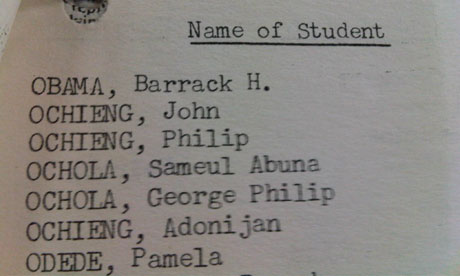


Barrack H. Obama is listed as a Kenyan student studying in America in 1959. US officials complained that Kenyan students were becoming "anti-American and anti-white" just at the time Barack Obama Senior was given a grant to study in America.

According to the article at The Guardian, the African American Students Foundation granted Obama, Sr. a scholarship to study business administration at the University of Hawaii, Honululu. Supporters of the project included the singer Harry Belafonte, the actor Sidney Poitier, and the baseball player Jackie Robinson. Also, "OBAMA, Barrack H" is in the file of Kenyan students in the US drawn up by British colonial officials.


Index of Articles by Sven Magnussen

Complete Index of Articles by Sven Magnussen